
An email address can win trust, or quietly lose it before anyone clicks reply. For small businesses, that choice often comes down to business email hosting or a free inbox like Gmail or Yahoo.
We get why free email looks tempting. It costs nothing, it works fast, and it feels familiar. But once money, credibility, and customer support enter the picture, free email starts to look like borrowed office space.
So if your website carries your brand, your inbox should too.
Why your email address shapes trust faster than you think
When we help small businesses set up their online presence, email is rarely the flashy part. Still, it affects first impressions almost as much as the website itself. A branded address like hello@yourbusiness.com looks established. An address like yourbusinessname2026@gmail.com feels temporary.
That gap matters. Recent April 2026 reporting found that emails from free domains are ignored about 35% more often than branded addresses. That lines up with the argument in why a free Gmail address can hurt your business. People don’t study your email choice in detail, but they feel it right away.
Free email also keeps your brand in second place. Every message promotes Gmail, Yahoo, or Outlook.com first, and your business second. With business email hosting, your domain sits front and center in every quote, invoice, follow-up, and support reply.
There’s also a control issue. If one team member leaves, who owns the inbox history? Who resets passwords? Who gets forwarded mail from old contacts? Business email hosting gives us admin control, user accounts, aliases, and a cleaner handoff when a business grows past one person.
Security plays a part too. Hosted business email usually supports SPF, DKIM, and DMARC. Those records help mailbox providers trust your mail. As a result, your messages have a better shot at landing in the inbox, not spam.
Free email saves a few dollars. Lost trust costs much more.
Business email hosting vs free email, side by side
The difference gets clearer when we put both options next to each other.
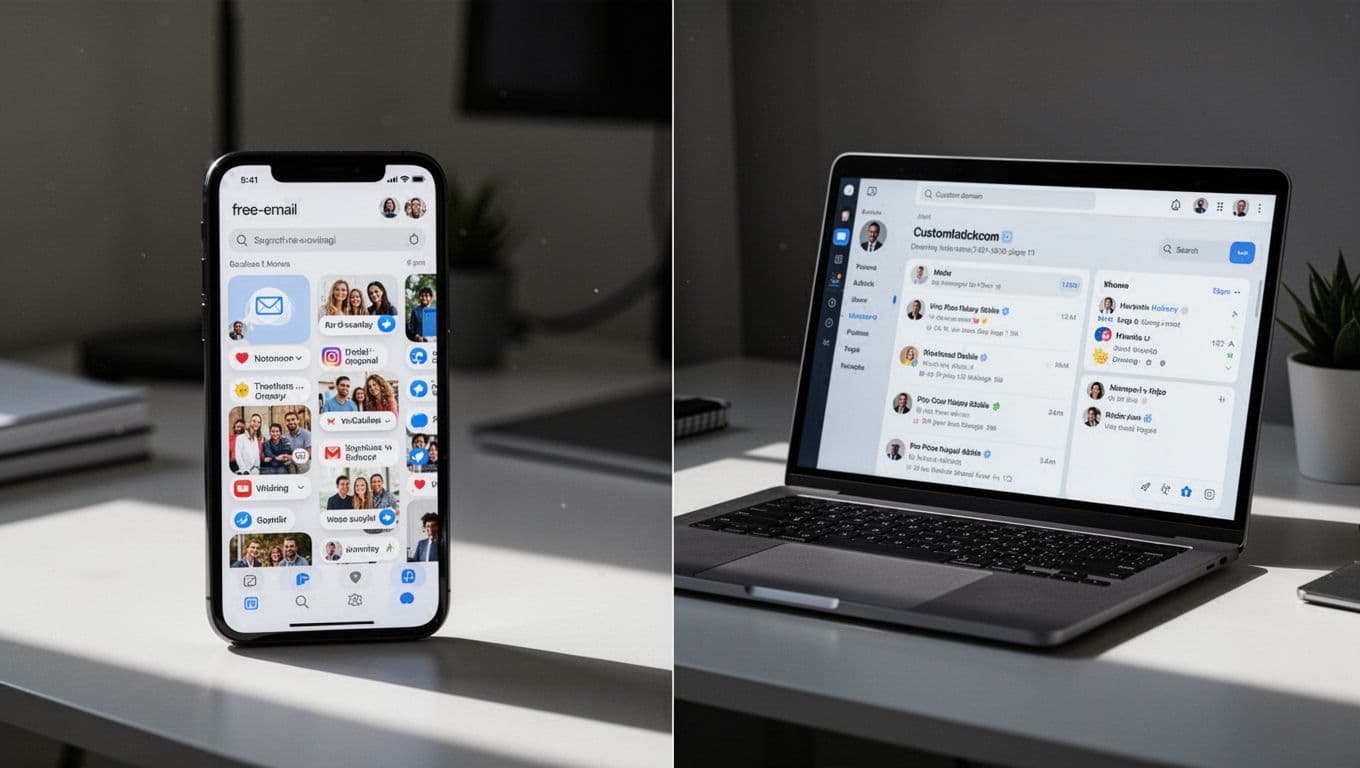
| Area | Business email hosting | Free email | | | | | | Brand image | Uses your domain and looks established | Looks personal or early-stage | | Inbox placement | Better support for email authentication | Less control over deliverability | | Team management | Add users, aliases, shared mailboxes | Built for individuals first | | Security | Admin tools, policy controls, account ownership | Fewer business controls | | Long-term cost | Monthly fee, but fewer missed leads | No fee, but higher hidden cost | | Ownership | Your company keeps the address | Tied to personal accounts more often |
The big takeaway is simple. Free email looks cheaper only if we ignore what happens after send.
A strong comparison from email costs, security, and deliverability reaches the same core point. The fee for hosted email is small. The cost of looking less trustworthy, missing replies, or losing account control is often much higher.
We also like business email hosting because it scales without drama. Start with one mailbox today. Add sales, support, billing, or hiring addresses later. Keep the same domain, the same brand, and the same customer confidence. That kind of consistency matters when your site starts getting traffic and your inbox gets busy.
Where free email still works, and where it starts costing you
Free email isn’t useless. We wouldn’t pretend it has no place. If we’re testing a hobby idea, joining tools, or keeping a personal side project off the ground, a free inbox can do the job.
But that window closes fast. Once a business has a domain, a live website, or customers who pay real money, the inbox should match the rest of the operation.
Free email starts to hurt when we:
- send quotes, invoices, or contracts
- reply to customer support requests
- hire a second person who needs a branded mailbox
- want one inbox to survive staff changes
- care whether sales emails land in spam
Think of it like signage on a storefront. A paper note taped to the door works for a garage sale. It doesn’t work for a shop that wants repeat customers.
Business email hosting also helps when we want cleaner organization. Separate addresses for support, billing, and sales look better than one personal inbox doing everything. It also keeps work from piling into a single account that becomes harder to manage each month.
For small businesses, this is where the switch usually happens. Not because email got more complex, but because the brand got more real.
The better buy for small teams building for growth
If we’re already paying for a domain and web hosting, keeping business email on a free service creates a weak link. The smarter move is to connect your email to the same serious brand you’re building everywhere else.
That’s why we usually point growing teams toward Microsoft 365 business email hosting. It gives you branded Outlook email, mobile access, calendars, and admin control in one place. For many small businesses, that’s the sweet spot, familiar tools, strong uptime, and room to add users as the team expands.
This is also where buying from us makes practical sense. You can keep your website, domain, and email under one roof, which means less account sprawl and less finger-pointing when you need help. That’s not a small win. It’s time back in your day.
An email address can close a sale or quietly kill it. That hasn’t changed.
Free email is fine for testing. Business email hosting is for businesses that want trust, control, and a brand that looks ready now.
If your next invoice, proposal, or customer reply still comes from a free inbox, this is the moment to change it.