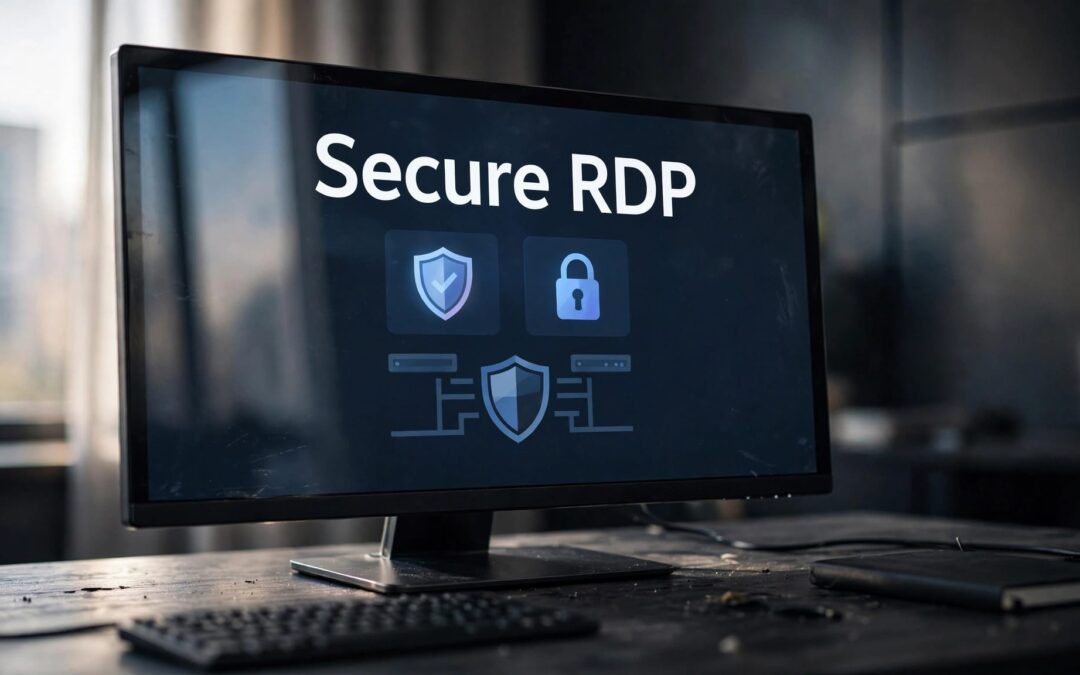
To secure the Remote Desktop Protocol (RDP) on a Windows VPS, keep access behind a VPN or RD Gateway and restrict it with firewall rules. Encryption protects your remote desktop connection, but access controls decide who gets through.
A Windows VPS gives you administrator access for custom IIS setups, .NET applications, and business software. That freedom comes with responsibility for RDP access, updates, accounts, and security.
Set up a private network route and firewall restrictions. Then require NLA/TLS and MFA, limit accounts, patch Windows, and verify access while keeping a recovery route available.
Key takeaways
- Keep TCP port 3389 off the public internet. Route connections through a VPN or RD Gateway.
- Require NLA, trusted TLS encryption, and MFA at the remote-access entry point.
- Limit permissions, patch Windows, and monitor logons. Test a second connection before closing your working session.
Start secure RDP access at the network boundary
Your first security setting belongs outside the Windows desktop. Before changing anything, open your hosting console and keep your current RDP session running.

Choose a VPN or RD Gateway
TCP 3389 is the default listening port for Remote Desktop Protocol (RDP), so don't expose it directly to the internet. A VPN creates a private route to your VPS. Microsoft's Remote Desktop Gateway guidance describes a gateway that authenticates users before forwarding connections internally.
RD Gateway accepts HTTPS connections on TCP 443. Deploy it separately, install a trusted certificate, and configure Connection Authorization Policies for permitted users. Resource Authorization Policies should identify the servers they can reach.
Berkeley estimates roughly 30-100 concurrent users per gateway. Treat that as rough planning guidance, not guaranteed capacity.
Restrict both firewall layers
Apply restrictions in your provider firewall and Windows Defender Firewall with Advanced Security (wf.msc).
Open the inbound Remote Desktop rule's Scope tab. Under Remote IP address, select "These IP addresses" and add only your VPN pool's IP address range or the gateway's private IP address. Remove broader overlapping allow rules.
Restrict UDP 3389 too, if enabled. Otherwise, you leave another RDP transport exposed.
Changing the listening port reduces scanner noise and can avoid default-port attacks such as Morto. It's security by obscurity, not a security boundary.
Require NLA and trusted TLS encryption
A reachable server still needs to reject unsafe connections. We recommend enforcing authentication early and using certificates your client can trust.
Enable Network Level Authentication
Network Level Authentication (NLA) requires users to authenticate before a full RDP session starts. That reduces resources consumed by unauthenticated connection attempts.
Run SystemPropertiesRemote.exe. Enable Remote Desktop and select the option requiring Network Level Authentication.
For centralized enforcement on a Remote Desktop Services host, open Computer Configuration > Administrative Templates > Windows Components > Remote Desktop Services > Remote Desktop Session Host > Security. Enable "Require user authentication for remote connections by using Network Level Authentication."
Berkeley lists NLA as enabled by default on Windows 10 and Windows Server 2012 R2, 2016, and 2019. Enforce the setting rather than assuming an older server image preserved that default.
Require TLS and validate certificates
Modern RDP environments can use TLS 1.2 and, where the implementation supports it, TLS 1.3. Older native RDP encryption isn't equivalent to TLS.
In the same Security policy folder, enable "Require use of specific security layer for remote (RDP) connections" and select SSL (TLS). The policy's legacy wording doesn't establish the negotiated TLS version.
Bind a certificate matching the server's hostname to the RDP listener. Microsoft's RDS certificate guidance explains how certificates support encryption and server identity.
To inspect the negotiated protocol, capture a test connection with Wireshark. Examine the TLS Server Hello and its supported_versions extension where present. Gateway HTTPS and gateway-to-host RDP are separate connections.
A certificate warning can indicate an identity problem. Don't make bypassing it part of your login routine.
Protect sign-ins with MFA and least privilege
A password shouldn't carry the whole security load. Secure RDP access also needs a second factor and a short list of authorized users.
Put MFA on the route users actually take
Require multi-factor authentication (MFA) through your VPN or RD Gateway authentication integration. Then block routes that bypass it.
AdminDroid recommends phishing-resistant methods such as FIDO2 security keys. SMS codes can be intercepted, and both SMS and TOTP codes can be phished.
Choose an entry point that supports your intended authentication method. A security key doesn't automatically add MFA to every native Windows RDP password prompt.
Give each administrator a unique account and password. Use strong passwords stored in a password manager. Shared logins make access harder to revoke and actions harder to trace.
Restrict who can log on
Open secpol.msc, then Local Policies > User Rights Assignment > "Allow log on through Remote Desktop Services." Grant that right only to the accounts or groups that need it.
If your policy requires restricted administrator logons, replace the broad Administrators grant with a designated RDP access group. Test another authorized login before ending your working session.
Also remove unnecessary members from Remote Desktop Users. Administrators isn't normally nested inside that group, so changing group membership alone won't remove the separate administrator logon right.
Use non-administrator accounts for routine application work. Reserve elevation for tasks that need it.
Limit failed attempts and unattended sessions
Repeated login attempts drive brute-force attacks. A carefully configured account lockout policy slows brute-force attacks, while session timeouts reduce unattended access.
These are useful starting points, not universal settings for every workload.
| Control | Starting point | Operational caution |
|---|---|---|
| Failed login threshold | 3-5 attempts | Attackers can deliberately trigger lockouts. |
| Lockout duration | Berkeley suggests 3 minutes after 3 failures | Configure the counter-reset interval too. |
| Idle session timeout | 10-15 minutes for high-security use | About 30 minutes suits general use. |
AdminDroid gives the 3-5-attempt range and those idle-timeout recommendations. We recommend applying them alongside network restrictions, rather than relying on lockouts alone.
Configure lockout settings under Account Policies > Account Lockout Policy in Local Security Policy or the applicable domain policy.
Set inactivity limits under Remote Desktop Session Host > Session Time Limits in Group Policy. Disconnecting isn't signing out: applications can keep running. Set a separate disconnected-session limit when sessions should eventually end, and account for unsaved work.
Patch Windows and protect administrator credentials
A firewall reduces exposure. Updates address vulnerabilities in the software behind it. Both jobs need an owner.
Maintain the whole Windows stack
Schedule security patches and required restarts, and update IIS, .NET, databases, and installed applications. A pending reboot can leave an update incomplete.
BlueKeep, CVE-2019-0708, affected older systems including Windows 7, Windows Server 2008, and Windows Server 2003. Microsoft described it as pre-authentication and wormable, meaning exploitation didn't require a normal login and could spread between vulnerable systems.
NLA helps reduce exposure, but it doesn't replace patching. For any legacy host still in service, verify that the BlueKeep security update is installed. Use supported Windows Server releases for new deployments.
Connect by hostname where Kerberos is available
Use a hostname or FQDN rather than an IP address in Kerberos-capable environments. IP-based connections normally fall back to NTLM, which carries credential-relay and pass-the-hash risks.
Microsoft's Remote Credential Guard requirements explain its reliance on Kerberos. Ordinary IP-address connections prevent it from working.
A hostname alone doesn't give a standalone VPS Kerberos authentication. Domain membership, DNS, and service configuration also matter. Protect administrator and break-glass accounts with strong passwords, and limit who can use them.
Verify access and monitor the right events
Settings only help when they work as intended. Test both the allowed route and the blocked route before you finish setup.
Test access without locking yourself out
From a computer outside the VPN, run Test-NetConnection against the VPS public address with -Port 3389. TcpTestSucceeded should be False.
Connect through the VPN or gateway, then start a second RDP session with an authorized account. Confirm that multi-factor authentication (MFA) prompts you, the certificate is trusted, and unauthorized accounts are rejected.
A failed port test alone doesn't prove every firewall rule is correct. Pair it with a successful connection through your intended private route.
Read actual logon evidence
Enable success and failure auditing for Logon under Advanced Audit Policy Configuration. Then review remote access logs in Event Viewer.
Use these events to distinguish authentication from a completed session.
| Event | Location | What it tells you |
|---|---|---|
| 4624, Logon Type 10 | Windows Logs > Security | Successful RemoteInteractive logon |
| 4625 | Windows Logs > Security | Failed logon; inspect type, address, and status |
| 1149 | RemoteConnectionManager > Operational | Authentication succeeded, not necessarily session creation |
| 21 | LocalSessionManager > Operational | Session logon succeeded |
Microsoft's Event 4624 documentation identifies Logon Type 10 as RemoteInteractive. NLA failures can appear as network logons, so don't filter failures exclusively to Type 10.
For any retained legacy host, verify that applicable BlueKeep remediation is installed. Alert on repeated failures that may indicate brute-force attacks, unfamiliar source IP addresses, and unexpected administrator logons.
Choose Windows VPS control with clear responsibilities
A blank Windows VPS gives you room to install proprietary software, configure IIS, and build the .NET environment your application needs. A control panel can simplify website administration, but it doesn't replace RDP hardening.
Our Windows VPS hosting options include Plesk and no-panel configurations. Choose Plesk when you want a central interface for hosting tasks. Choose no panel when direct Windows administration fits your workload.
Either way, our self-managed VPS responsibilities guide sets out the ongoing work: updates, access controls, monitoring, and recovery. Full control works better when those responsibilities are assigned before launch.
Frequently asked questions
Is Remote Desktop secure enough for a Windows VPS?
Yes, with layered controls: private access, NLA, trusted TLS, MFA, limited permissions, and updates. Encryption alone won't stop someone using stolen credentials.
Does an RD Gateway replace a VPN?
It can replace a VPN for publishing authorized RDP resources. It doesn't provide general private-network access for every application. Choose based on the services your administrators need.
Can a hosting control panel replace RDP security?
No. Plesk helps with hosting administration, but RDP remains a separate access route whenever it's enabled. Its firewall rules, authentication, and permissions still need protection.
Keep control without leaving access open
Secure RDP access starts with a private entry point and continues with controlled accounts, patched software, and useful logs. A strong password is one layer of that setup.
We recommend establishing the VPN or gateway first, then testing each restriction before removing your recovery route. Your VPS stays accessible to the right people, with fewer openings for everyone else.